 Canada
 U.S.A.
 International
 100% Canadian Made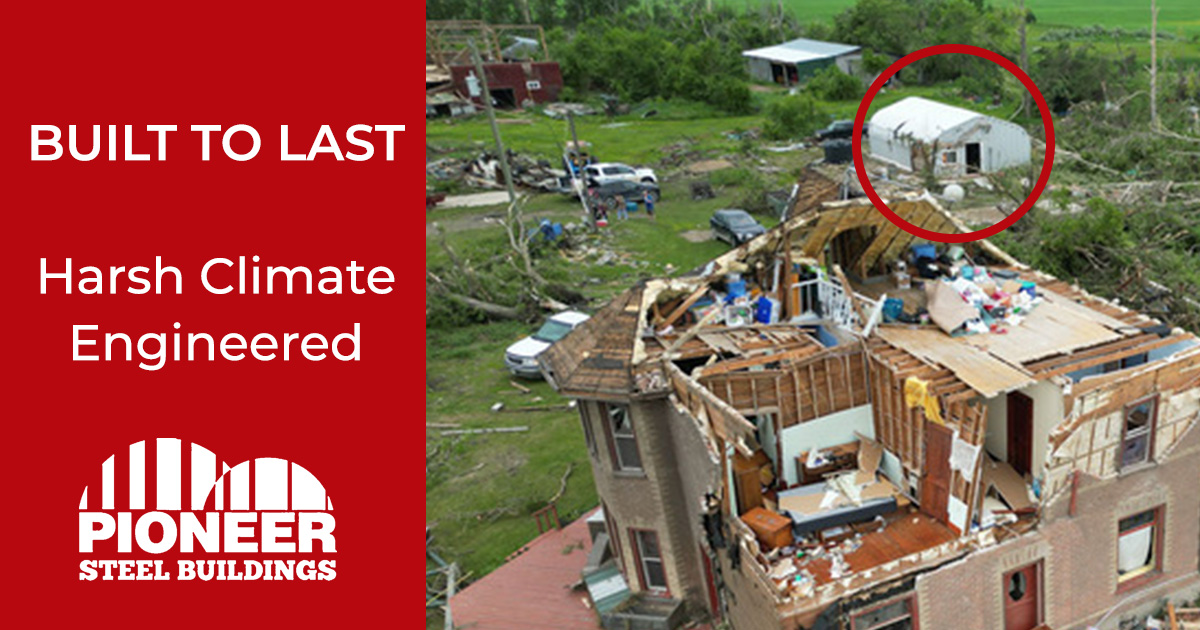
Their home and six outbuildings were destroyed. Their Pioneer Steel workshop remained standing.
On June 28, 2026, an EF-3 tornado tore through Brian and Bernadine Brown’s property near Rossburn, Manitoba. Their home was destroyed. So were six outbuildings on their 20-acre property.
One building survived: the Pioneer Steel workshop they purchased in 2020.
It is a remarkable outcome from a devastating storm, and a powerful real-world example of why buildings in Canada need to be engineered for conditions that can be anything but ordinary.
A Summer of Severe Weather Across Canada
The Rossburn tornado is part of a summer that has brought damaging weather to communities across Canada.
Environment and Climate Change Canada entered the season forecasting warmer-than-normal temperatures across most of the country and warning that thunderstorms remain one of Canada’s most frequent hazardous weather events, capable of producing hail, damaging winds, flash floods and tornadoes.
This summer, Agriculture and Agri-Food Canada was reporting a striking range of weather impacts nationwide: drought and wildfire concerns in British Columbia, severe storms, flooding, hail and wind damage across the Prairies, wildfires in northwestern Ontario, and extreme heat and localized flooding in parts of Ontario and Quebec. In Manitoba specifically, severe storms produced flooding, standing water, hail damage and significant infrastructure and crop losses.
For the Browns, the danger arrived directly at their home.
The June 28 Rossburn Tornado
The Northern Tornadoes Project confirmed that the June 28 supercell produced an EF-3 tornado in the Rossburn area as well as two additional tornadoes in nearby Riding Mountain National Park. Those later tornadoes were rated EF-1 and EF-2.
CBC News reported that EF-3 tornadoes correspond to estimated wind speeds of 225 to 265 km/h. By July 10, Manitoba had already recorded 10 tornadoes in 2026, above its 30-year annual average of 8.5, with much of the peak tornado season still remaining.
Read CBC News coverage of the June 28 Manitoba tornadoes.
“The Only Building That Withstood It Was the Workshop”
Brian and Bernadine Brown contacted Pioneer Steel after the tornado to tell us what they found when they surveyed the damage:
“My wife and I purchased one of your buildings in 2020 to use as a workshop. We recently experienced a tornado which totally destroyed our home and six outbuildings on our 20-acre yardsite. The only building that withstood the 235 km/h winds and an F3 tornado was the
Their home and six outbuildings were gone.
Their Pioneer Steel workshop was still standing.
No building can be guaranteed to survive every tornado or extreme-weather event. Tornado damage depends on many factors, including the path and intensity of the storm, debris impacts, site conditions, foundations and the individual structure.
But the Browns’ experience demonstrates something important: when severe weather arrives, structural engineering matters.
Engineered for Canadian Conditions
Canada presents buildings with an unusually demanding combination of environmental challenges: Prairie windstorms, heavy snow loads, coastal moisture and corrosion, flooding, wildfire exposure and large seasonal temperature swings.
Pioneer Steel buildings are engineered with the conditions of the region in which they will be installed in mind. Snow load, wind exposure, moisture and corrosion risk can all affect structural requirements and are considered early in the design process.
In high-wind environments, engineering involves more than the exterior shape of a building. Wind forces can affect walls and roofs as well as connections, foundations and resistance to uplift. Pioneer Steel systems are engineered to meet applicable regional wind-load requirements, with consideration given to structural stability, anchoring, connections and site-specific foundation designs.
For owners planning to use a building for decades, that resilience matters.
Sometimes the true test of a building does not come during an ordinary Canadian winter or an average summer day.
Sometimes it comes on a day like June 28.
For Brian and Bernadine Brown, almost every building on their property was lost.
The Pioneer Steel building remained.